Thoughts · 04 Nov 2026 · 5 min
AI wrote 30% more code. The finished work did not move. The biggest AI study of the year explains where your hours will go.
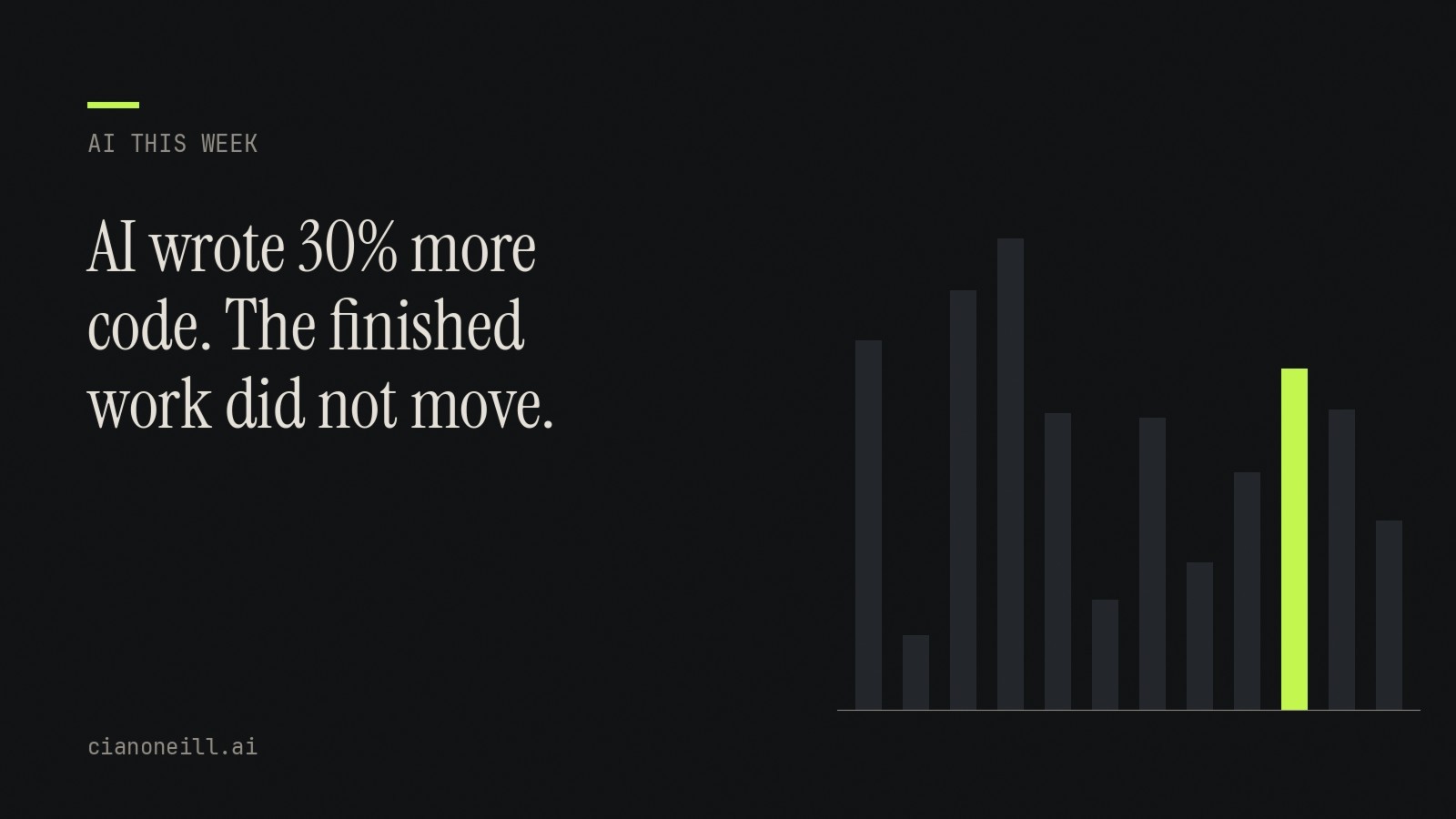
A Harvard study of 718 firms found AI agents raised code output 30% and finished work 0%. The bottleneck moved to the human who checks.
Seven hundred and eighteen companies. About 726,000 people. Five years of their work logs. And the number that matters in the whole study is a zero.
That is the short version of a paper two Harvard economists, Fiona Chen and James Stratton, put out this year and that got its moment this week after TechRadar, ComplexDiscovery and a pile of newsletters picked it up. I am not an engineer and I cannot write code. I still think it is the most useful thing published about AI at work in months, because it is about what happens after the AI has done its bit. That part is where most of us live.
What happened
The paper is called Artificial Intelligence in the Firm: Bottlenecks in Software Production. The authors got anonymised activity data from Jellyfish, a platform that tracks engineering work for its client companies, and matched it to employment records. The sample runs from January 2021 to March 2026 and covers about 300 million work events: 68 million task tickets, 201 million code commits and 49 million pull requests. By January 2026, more than 95% of the firms had adopted AI coding agents in some form.
Then they compared each company before and after it switched the agents on.
The front half of the result is exactly what the vendors promise. Lines of code per person went up about 30%. Commits, which are saved batches of changes, went up 20%. Pull requests, which are finished changes submitted for a colleague to approve, went up 23%.
The back half is the zero. Resolved tickets, the unit of actual finished work in these companies, showed no statistically significant change. The authors can rule out any gain bigger than about 12%. Nobody was writing bigger tickets either, so it is not that the same count hid more work. And employment did not move in any clear direction.
How it works, in plain words
In software, nothing you write counts until somebody else has read it. A pull request sits in a queue until a colleague reviews it, asks for changes if needed, and merges it. That review step is where the 30% went.
After the agents arrived, the average wait from submitting a change to merging it rose from 7.03 days to 10.48 days, which is 49% longer. The share of changes sent back with a formal request for corrections nearly doubled, from about 13% to about 25%. Reviewers left 35% more comments per change. And companies quietly moved more people onto review duty: the share of workers doing any reviewing rose 14%.
The authors’ own line in the abstract is that the gains “do not fully pass through to changes in software output or employment,” and that for agents “this incomplete pass-through reflects a bottleneck from code review.”
Two things I found striking in the write-ups. First, these companies had already tried to automate the checking. By March 2026 nearly 80% of them used an AI review tool, yet AI wrote only 23% of review comments and most of the reading still fell on humans. Second, the data stops in March 2026, and the agents have got better since, so the gap may have narrowed. Aivy makes that point and I think it is fair. But the shape of the problem is not going anywhere.
What this means if you have never seen a line of code
You do not need to know what a pull request is. Here is the finding with the jargon taken out. Software teams work in two steps: someone writes something, then someone else checks it before it goes out. AI made the first step much faster. The second step did not speed up, and it got heavier.
Now swap the words. Replace “code” with “proposals,” “reports,” “contracts,” “ad copy,” “product listings” or “slide decks.” Replace “code review” with “the person who has to read it before it goes out.”
When a tool makes the first draft cheap, the first draft stops being the expensive part. The expensive part becomes the checking, the correcting and the deciding. If you do not plan for that, your team produces more drafts, your reviewers drown, and the number your boss actually looks at, finished things, stays flat. Worse, the AI-written drafts came back with corrections twice as often, so each one cost more to check than the old hand-written ones did.
What I make of it
The tools did not get slower. The queue got longer, because the tools are now feeding it.
The lesson I have taken is that the review step is the product. The drafting is a commodity. If you are going to put AI to work on anything that leaves the building, design the checking first: who reads it, how long they get, what “done” looks like, and what gets sent back. Then let the drafting run as hard as it likes.
What I’d tell you
Measure finished work, not output. Lines, drafts, posts and emails sent are the 30%. Tickets closed, deals signed, customers served are the zero. If the second number is not moving, the first one is noise.
Budget the review hours before you buy the tool. If a draft takes a tenth of the time to produce and twice the time to check, the maths changes. Put the reviewer’s hours in the business case, not just the writer’s.
Make the drafts smaller. A ten-page proposal is a ten-day review. Three two-page sections get read today. The study found bigger queues, not bigger changes, so batch size is the lever you still control.
Let AI pre-check, but keep a human at the gate. The companies in the study used AI review tools and still needed people for three quarters of the comments. Use the machine to catch the obvious, and save the human for the judgement.
And keep the human check, however short. Mine is ten minutes a day, and it caught a five-legged dog that would have gone out under the store’s name. That was not a drafting problem. It was a review problem, and review is the job now.
If you want the next one in your inbox, The Build Log goes out from cianoneill.ai/subscribe. New subscribers get the Store Blueprint kit, the exact setup I used for my online store, review sheet included.